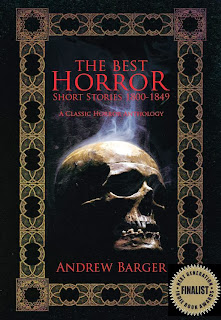
Best Horror Short Stories 1850-1899 Annotated
by
Exciting news in the horror world. This week I have pre-published my latest horror anthology -
Best Horror Short Stories 1850-1899: A 6a66le Horror Anthology. It launched October 8th just in time for the bewitching season. You can purchase it on Kindle for $2.99 during the pre-launch period. Order today!
In the best horror collection I include annotated versions of the 10 finest horror stories for the last half of the nineteenth century. Today I am counting down the Top 20 for this period and will stop at 10, which can be found with loads of information and story background in the new book. Let's get started, shall we?
20
Best Horror Short Story 1850-1899
A Game of Chess
by
Robert Barr
Robert Barr (left with goatee) with Sir Arthur Conan Doyle (middle)
Circa 1907
Robert Barr is the first Scottish author to appear in this horror anthology. When a child, Barr’s parents moved him to Canada and one of his first professional jobs was as a teacher at Central School of Windsor, Ontario. There he worked his way up to headmaster. Upon crossing the border into Michigan, he later was appointed the news editor of the Detroit Free Press newspaper.
Later in life he moved to London where he befriended the likes of Jerome K. Jerome and Sir Arthur Conan Doyle. Barr penned one of the first Sherlock Holmes parodies “The Adventures of Sherlaw Kombs.” Doyle would later described his personality as having “a violent manner, a wealth of strong adjectives, and one of the kindest natures underneath it all."
Barr wrote a selection of forgotten novels, some of which dabble in the horror genre, but what outshines them all is “A Game of Chess” published in 1893.
William Mudford used a mechanical device in
The Iron Shroud (1830) and Edgar Allan Poe used a swinging blade on the end of a pendulum in
The Pit and the Pendulum (1843), but neither used electricity. It was Mary Shelley who first used electricity to twitch a muscle, (galvanism) including the heart, to bring Frankenstein’s monster to life. Certainly early forms of electrical mechanisms were known after Shelley’s popular novel
Frankenstein, Or the Modern Prometheus was published much earlier in 1818, but neither Mudford nor Poe used it as a plot device.
Robert Barr, however, is perhaps the first to use electricity in a horror short story to inflict torture and he builds terror was deft precision in “A Game of Chess.”
A Game of Chess
1893
by
Robert Barr
HERE FOLLOWS A rough translation of the letter which Henri Drumont wrote in Boukrah, two days before his death, to his uncle, Count Ferrand, in Paris. It explains the incidents which led up to the situation hereinafter to be described:—
My Dear Uncle,
You will have gathered from former letters of mine, that, when one gets east of Buda Pest, official corruption becomes rampant to an extent hardly believable in the west. Goodness knows, things are bad enough in Paris, but Paris official life is comparatively clean when brought into contrast with Boukrah. I was well aware before I left France that much money would have to be secretly spent if we were to secure the concession for lighting Boukrah with electricity, but I was unprepared for the exactions that were actually levied upon me. It must be admitted that the officials are rapacious enough, but once bought, they remain bought, or, at least, such has been my experience of them.
There are, however, a horde of hangers-on, who seem even more insatiable than the governing body of the town, and the worst of these is one Schwikoff, editor of the leading paper here, the Boukrah Gazette, which is merely a daily blackmailing sheet. He has every qualification needed by an editor of a paper in Eastern Europe, which may be summed up by saying that he is demoniacally expert with the rapier, and a dead shot with a pistol. He has said time and again that his scurrilous paper could wreck our scheme, and I believe there is some truth in his assertion Be that as it may, I have paid him at different times large sums of money, but each payment seems but the precursor of a more o’trageous demand. At last I was compelled to refuse further contributions to his banking account, and the young man smiled, saying he hoped my decision was not final, for, if it was, I should regret it. Although Schwikoff did not know it, I had the concession signed and completed at that moment, which document I sent to you yesterday morning. I expected Schwikoff would be very angry when he learned of this, but such did not appear to be the case.
He met me last night in the smoking-room of the Imperial Club, and shook hands with great apparent cordiality, laughing over his discomfiture, and assuring me that I was one of the shrewdest business men he had ever met. I was glad to see him take it in this way, and later in the evening when he asked me to have a game of chess with him, I accepted his invitation, thinking it better for the Company that he should be a friend, if he were so disposed.
We had not progressed far with the game, when he suddenly accused me of making a move I had no right to make. I endeavored to explain, but he sprang up in an assumed rage and dashed a glass of wine in my face. The room was crowded with officers and gentlemen. I know you may think me foolish for having sent my seconds to such a man as Schwikoff, who is a well-known blackmailer, but, nevertheless, he comes of a good family, and I, who have served in the French Army Co., and am of your blood, could not accept tamely such an insult.
If what I hear of his skill as a swordsman is true, I enter the contest well aware that I am outclassed, for I fear I have neglected the training of my right arm in my recent pursuit of scientific knowledge. Whatever may be the outcome, I have the satisfaction of knowing that the task given me has been accomplished. Our Company has now the right to establish its plant and lay its wires in Boukrah, and the people here have such an Eastern delight in all that is brilliant and glittering, that I feel certain our project will be a financial success.
Schwikoff and I will meet about the time you receive this letter, or, perhaps, a little earlier, for we fight at daybreak, with rapiers, in the large room of the Fencing School of Arms in this place.
Accept, my dear uncle, the assurance of my most affectionate consideration.
—Your unworthy nephew,
Henki.
The old man’s hand trembled as he laid down the letter after reading it and glanced up at the clock. It was the morning of the duel, and daylight came earlier at Boukrah than at Paris.
Count Ferrand was a member of an old French family that had been impoverished by the Revolution. [French Revolution 1789-1799] Since then, the Ferrand family had lived poorly enough until the Count, as a young man, had turned his attention towards science, and now, in his old age, he was supposed to possess fabulous wealth, and was known to be the head of one of the largest electric manufacturing companies in the environs of Paris.
No one at the works was aware that the young man, Henri Drumont, who was given employ in the manufactory after he had served his time in the army, was the nephew of the old Count, for the head of the company believed that the young man would come to a more accurate knowledge of the business if he had to take the rough with the smooth, and learn his trade from the bottom upwards.
The glance at the clock told the old Count that the duel, whatever its result, had taken place. So there was nothing to be done but await tidings. It was the manager of the works who brought them in.
“I am sorry to inform you, sir,” he said, “that the young man, Henri Drumont, whom we sent to Boukrah, was killed this morning in a duel. His assistant telegraphs for instructions. The young man has no relatives here that I know of, so I suppose it would be as well to have him buried where he died.”
The manager had no suspicion that he was telling his Chief of the death of his heir.
“The body is to be brought back to France,” said the Count quietly.
And it was done. Later, when the question arose of the action to be taken regarding the concession received from Boukrah, the Count astonished the directors by announcing that, as the concession was an important one, he himself would take the journey to Boukrah, and remain there until the electric plant, already forwarded, was in position, and a suitable local manager found,
The Count took the Orient Express from Paris, and, arriving In Boukrah, applied himself with an energy hardly to be expected from one of his years, to the completion of the work which was to supply the city with electricity.
Count Ferrand refused himself to all callers until the electric plant was in operation, and the interior of the building he had bought, completed to his satisfaction. Then, practically the first man admitted to his private office was Schwikoff, editor of the Boukrah Gazette. He had sent in his card with a request, written in passable French, for information regarding the electrical installation, which would be of interest, he said, to the readers of the “Gazette.”
Thus Schwikoff was admitted to the presence of Count Ferrand, whose nephew he had killed, but the journalist, of course, knew nothing of the relationship between the two men, and thought, perhaps, he had done the courteous old gentleman a favor, in removing from the path of his advancement the young man who had been in the position now held by this grey-haired veteran.
The ancient noble received his visitor with scrupulous courtesy, and the blackmailer, glancing at his hard, inscrutable face, lined with experience, thought that here, perhaps, he had a more difficult victim to bleed than the free-handed young fellow whom he had so deferentially removed from existence, adhering strictly to the rules of the game, himself acquitted of all guilt by the law of his country, and the custom of his city, passing unscathed into his customary walk of life, free to rapier the next man who offended him. Count Ferrand said politely that he was ready to impart all the information in his possession for the purposes of publication. The young man smiled and shrugged his shoulders slightly.
“To tell you the truth, sir, at once and bluntly, I do not come so much for the purpose of questioning you regarding your business, as with the object of making some arrangement concerning the Press, with which I have the great honor to be connected. You may be aware, sir, that much of the success of your company will depend on the attitude of the Press towards you. I thought, perhaps, you might be able to suggest some method by which all difficulties would be smoothed away; a method that would result in our mutual advantage.”
“I shall not pretend to misunderstand you,” replied the Count, “but I was led to believe that large sums had already been disbursed, and that the difficulties, as you term them, had already been removed.”
“So far as I am concerned,” returned the blackmailer, “the sums paid to me were comparatively trivial, and I was led to hope that when the company came into active operation, as, thanks to your energy, is now the case, it would deal more liberally with me.”
The Count in silence glanced at some papers he took from a pigeonhole, then made a few notes on the pad before him. At last he spoke.
“Am I right in stating that an amount exceeding ten thousand francs was paid to you by my predecessor, in order that the influence of your paper might be assured?”
Schwikoff again shrugged his shoulders.
“It may have been something like that,” he said carelessly. “I do not keep any account of these matters.”
“It is a large sum,” persisted Ferrand.
“Oh! a respectable sum; but still you must remember what you got for it. You have the right to bleed forever all the inhabitants of Boukrah.”
“And that gives you the right to bleed us?”
“Oh! if you like to put it that way, yes. We give you quid pro quo [This for taht] by standing up for you when complaints of your exactions are made.”
“Precisely. But I am a business man, and would like to see where I am going. You would oblige me, then, by stating a definite sum, which would be received by you in satisfaction of all demands.”
“Well, in that case, I think twenty thousand francs would be a moderate amount.”
“I cannot say that moderation is the most striking feature of your proposal,’’ said the Count drily, “still we shall not trouble about that, if you will be reasonable in the matter of payment. I propose to pay you in instalments of a thousand francs a month.”
“That would take nearly two years,” objected Schwikoff. “Life is uncertain. Heaven only knows where we shall be two years from now.”
“Most true; or even a day hence. Still, we have spent a great deal of money on this establishment, and our income has not yet begun; therefore, on behalf of the company, I must insist on easy payments. I am willing, however, to make it two thousand francs a month, but beyond that I should not care to go without communicating with Paris.”
“Oh, well,” swaggered Schwikoff, with the air of a man making great concessions, “I suppose we may call that satisfactory, if you make the first payment now.”
“I do not keep such a sum in my office, and, besides, I wish to impose further terms. It is not my intention to make an arrangement with any but the leading paper of this place, which I understand the Gazette to be.”
“A laudable intention. The Gazette is the only paper that has any influence in Boukrah.”
“Very well; then I must ask you, for your own sake as for mine, to keep this matter a strict secret; even to deny that you receive a subsidy, if the question should come up.”
“Oh, certainly, certainly.”
“You will come for payment, which will be in gold, after office hours, on the first of each month. I shall be here alone to receive you. I should prefer that you came in by the back way, where your entrance will be unseen, and so we shall avoid comment, because, when I refuse the others, I should not care for them to know that one of their fellows has had an advantage over them. I shall take the money from the bank before it closes. What hour, therefore, after six o’clock will be most convenient to you?”
“That is immaterial—seven, eight, or nine, or even later, if you like.”
“Eight o’clock will do; by that time everyone will have left the building but myself. I do not care for late hours, even if they occur but once a month. At eight o’clock precisely you will find the door at the back ajar. Come in without announcement, so that we may not be taken by surprise. The door is self-locking, and you will find me here with the money. Now, that I may be able to obtain the gold in time, I must bid you adieu.”
At eight o’clock precisely Count Ferrand, standing in the passage, saw the backdoor shoved open and Schwikoff enter, closing it behind him.
“I hope I have not kept you waiting,” said Schwikoff.
“Your promptitude is exceptional,” said the other politely. “As a businessman. I must confess I like punctuality. I have left the money in the upper room. Will you have the goodness to follow me?”
They mounted four pairs of stairs, all lighted by incandescent lamps. Entering a passageway on the upper floor, the Count closed the big door behind him; then opening another door, they came to a large oblong room, occupying nearly the whole of the top story, brilliantly lighted by an electric luster depending from the ceiling.
“This is my experimenting laboratory,” said the old man as he closed the second door behind him.
It was certainly a remarkable room, entirely without windows. On the wall, at the right hand near the entrance, were numerous switches in shining brass and copper and steel.
From the door onward were perhaps ten feet of ordinary flooring, then across the whole width of the room extended a gigantic chess board, the squares yellow and grey, made alternately of copper and steel; beyond that again was another ten feet of plain flooring, which supported a desk and some chairs.
Schwikoff’s eyes glittered as he saw a pile of gold on the desk. Near the desk was a huge open fireplace, constructed like no fireplace Schwikoff had ever seen before. The center, where the grate should have been, was occupied by what looked like a great earthenware bath tub, some six or seven feet long.
“That,” said the electrician, noticing the other’s glance at it, “is an electric furnace of my own invention, probably the largest electric furnace in the world. I am convinced there is a great future before carbide of calcium, [Calcium carbide is a chemical compound used to make acetylene gas for lights or chemical fertilizers] and I am carrying on some experiments drifting towards the perfection of the electric crucible.’’ [Use of electricity to melt items in a container]
“Carbide of calcium?” echoed Schwikoff. “I never heard of it.”
“Perhaps it would not interest you, but it is curious from the fact that it is a rival of the electric light, and yet only through the aid of electricity is carbide of calcium made commercially possible.”
“Electricity creates its own rival, you mean; most interesting I am sure. And is this a chessboard let into the floor?”
“Yes, another of my inventions. I am a devotee of chess.”
“So am I.”
“Then we shall have to have a game together. You don’t object to high stakes I hope?”
“Oh, no, if I have the money.”
“Ah, well, we must have a game with stakes high enough to make the contest interesting.”
“Where are your chessmen? They must be huge.”
“Yes, this board was arranged so that living chessmen might play on it. You see, the alternate squares are of copper, the others of steel. That black line which surrounds each square is hard rubber, which does not allow the electricity to pass from one square to another.”
“You use electricity, then, in playing.”
“Oh, electricity is the motive power of the game; I will explain it all to you presently; meanwhile, would you oblige me by counting the gold on the desk? I think you will find there exactly two thousand francs.”
The old man led the way across the metal chessboard. He proffered a chair to Schwikoff, who sat down before the desk.
Count Ferrand took the remaining chair, carried it over the metal platform, and sat down near the switch, having thus the huge chessboard between him and his guest. He turned a lever from one polished knob to another, the transit causing a wicked, vivid flash to illuminate the room with the venomous glitter of blue lightning. Schwikoff gave a momentary start at the crackle and the blinding light. Then he continued his counting in silence. At last he looked up and said: “This amount is quite correct.”
“Please do not move from your chair,” commanded the Count. “I warn you that the chessboard is now a broad belt of death between you and me. On every disc the current is turned, and a man stepping anywhere on the board will receive into his body two thousand volts, killing him instantly as with a stroke of lightning, which, indeed, it is.”
“Is this a practical joke?” asked Schwikoff, turning a little pale about the lips, sitting still, as he had been ordered to do.
“It is practical enough, and no joke, as you will learn when you know more about it. You see this circle of twenty-four knobs at my hand, with each knob of which, alternately, this lever communicates when I turn it.”
As the Count spoke he moved the lever, which went crackling past a semicircle of knobs, emitting savage gleams of steel-like fire as it touched each metal projection.
“From each of these knobs,” explained the Count, as if he were giving a scientific lecture, “electricity is turned on to a certain combination of squares before you. When I began speaking, the whole board was electrified; now, a man might walk across that board, and his chances of reaching this side alive would be as three to one.”
Schwikoff sprang suddenly to his feet, terror in his face, and seemed about to make a dash for it. The old man pushed the lever back into its former position.
“I want you to understand,” said the Count suavely, “that, upon any movement on your part, I shall instantly electrify the whole board. And please remember that, although I can make the chessboard as safe as the floor, a push on this lever and the metal becomes a belt of destruction. You must keep a cool head on your shoulders, Mr. Schwikoff, otherwise you have no chance for your life.”
Schwikoff, standing there, stealthily drew a revolver from his hip pocket. The Count continued in even tones:
“I see you are armed, and I know you are an accurate marksman. You may easily shoot me dead as I sit here. I have thought that all out in the moments I have given to the consideration of this business. On my desk downstairs is a letter to the manager, saying that I am called suddenly to Paris, and that I shall not return for a month. I ask him to go on with the work, and tell him on no account to allow anyone to enter this room. You might shout till you were hoarse, but none outside would hear you. The walls and ceiling and floor have been deadened so effectively that we are practically in a silent, closed box. There is no exit except up through the chimney, but if you look at the crucible to which I called your attention you will see that it is now white hot, so there is no escape that way. You will, therefore, be imprisoned here until you starve to death, or until despair causes you to commit suicide by stepping on the electrified floor.”
“I can shatter your switchboard from here with bullets.”
“Try it,” said the old man calmly. “The destruction of the switchboard merely means that the electricity comes permanently on the floor. If you shatter the switchboard, it will then be out of my power to release you, even if I wished to do so, without going down stairs and turning off the electricity at the main. I assure you that all these things have had my most earnest consideration, and while it is possible that something may have been overlooked, it is hardly probable that you, in your now excited state of mind, will chance upon that omission.”
Schwikoff sank back in his chair.
“Why do you wish to murder me?” he asked. “You may retain your money, if that is what you want, and I shall keep quiet about you in the paper.”
“Oh, I care nothing for the money nor the paper.”
“Is it because I killed your predecessor?”
“My predecessor was my nephew and my heir. Through his duel with you, I am now a childless old man, whose riches are but an encumbrance to him, and yet those riches would buy me freedom were I to assassinate you in broad daylight on the street. Are you willing now to listen to the terms I propose to you?”
“Yes.”
“Very good. Throw your pistol into the corner of the room beside me; its possession will do you no good.”
After a moment’s hesitation, Schwikoff flung his pistol across the metal floor into the corner. The old man turned the lever to still another knob.
“Now,” he said, “you have a chance of life again; thirty-two of the squares are electrified, and thirty-two are harmless. Stand, I beg of you, on the square which belongs to the Black King.”
“And meet my death.”
“Not on that square, I assure you. It is perfectly safe.”
But the young man made no movement to comply.
“I ask you to explain your intention,” he said.
“You shall play the most sinister game of chess you have ever engaged in; Death will be your opponent. You shall have the right to the movements of the King—one square in any direction that you choose. You will never be in a position in which you have not the choice of at least two squares upon which you can step with impunity; in fact, you shall have at each move the choice of eight squares on which to set your foot, and as a general thing, four of those will mean safety, and the other four death, although sometimes the odds will be more heavily against you, and sometimes more strongly in your favor. If you reach this side unscathed, you are then at liberty to go, while if you touch one of the electric squares, your death will be instantaneous. Then I shall turn off the current, place your body in that electrical furnace, turn on the current again, with the result that for a few moments there will be thick, black smoke from the chimney, and a handful of white ashes in the crucible.”
“And you run no danger.”
“No more than you did when you stood up against my nephew, having previously unjustly insulted him.”
“The duel was carried out according to the laws of the code.”
“The laws of my code are more generous. You have a chance for your life. My nephew had no such favor shown to him; he was doomed from the beginning, and you knew it.”
“He had been an officer in the French Army.”
“He allowed his sword arm to get out of practice, which was wrong, of course, and he suffered for it.
However, we are not discussing him; it is your fate that is in question. I give you now two minutes in which to take your stand on the King’s square.”
“And if I refuse?”
“If you refuse, I turn the electricity on the whole board, and then I leave you. I will tear up the letter which is on my desk below, return here in the morning, give the alarm, say you broke in to rob me of the gold which is beside you on the desk, and give you in charge of the authorities, a disgraced man.”
“But what if I tell the truth?”
“You would not be believed, and I have pleasure in knowing that I have money enough to place you in prison for the rest of your life. The chances are, however, that, with the electricity fully turned on, this building will be burned down before morning. I fear my insulation is not perfect enough to withstand so strong a current. In fact, now that the thought has suggested itself to me, tire seems a good solution of the difficulty. I shall arrange the wires on leaving so that a conflagration will break out within an hour after my departure, and, I can assure you, you will not be rescued by the firemen when they understand their danger from live wires in a building from which, I will tell them, it is impossible to cut off the electricity. Now, sir, you have two minutes.”
Schwikoff stood still while Ferrand counted the seconds left to him; finally, as the time was about to expire, he stepped on the King’s square, and stood there, swaying slightly, drops of perspiration gathering on his brow.
“Brava!” cried the Count, “you see, as I told you, it is perfectly safe. I give you two minutes to make your next move.”
Schwikoff, with white lips, stepped diagonally to the square of the Queen’s Pawn, and stood there, breathing hard, but unharmed.
“Two minutes to make the next move,” said the old man, in the unimpassioned tones of a judge.
“No, no!” shouted Schwikoff excitedly, “I made my last move at once; I have nearly four minutes. I am not to be hurried; I must keep my head cool. I have, as you see, superb control over myself.”
His voice had now risen to a scream, and his open hand drew the perspiration down from his brow over his face, streaking it grimly.
“I am calm!” he shrieked, his knees knocking together, “but this is no game of chess; it is murder. In a game of chess I could take all the time I wanted in considering a move.”
“True, true!” said the old man suavely, leaning back in his chair, although his hand never left the black handle of the lever. “You are in the right. I apologize for my infringement of the laws of chess; take all the time you wish, we have the night before us.”
Schwikoff stood there long in the ominous silence, a silence interrupted now and then by a startling crackle from the direction of the glowing electric furnace. The air seemed charged with electricity and almost unbreathable. The time given him. so far from being an advantage, disintegrated his nerve, and as he looked fearfully over the metal chessboard the copper squares seemed to be glowing red hot, and the dangerous illusion that the steel squares were cool and safe became uppermost in his mind.
He drew back his foot quickly with a yell of terror.
He curbed with difficulty his desire to plunge, and stood balancing himself on his left foot, cautiously approaching the steel square with his right toe. As the boot scared the steel square, Schwikoff felt a strange thrill pass through his body. He drew back his foot quickly with a yell of terror, and stood, his body inclining now to the right, now to the left, like a tall tree hesitating before its fall. To save himself he crouched.
“Mercy! Mercy!” he cried. “I have been punished enough. I killed the man, but his death was sudden, and not fiendish torture like this. I have been punished enough.”
“Not so,” said the old man. “An eye for an eye.”
All self-control abandoned the victim. From his crouching position he sprang like a tiger. Almost before his outstretched hands touched the polished metal his body straightened and stiffened with a jerk, and as he fell, with a hissing sound, dead on the chessboard, the old man turned the lever free from the fatal knob. There was no compassion in his hard face for the executed man, but instead his eyes glittered with the scientific fervor of research. He rose, turned the body over with his foot, drew off one of the boots, and tore from the inside a thin sole of cork.
“Just as I thought,” he murmured. “Oh, the irony of ignorance! There existed, after all, the one condition I had not provided for. I knew he was protected the moment he stepped upon the second square, and, if his courage had not deserted him, he could have walked unharmed across the board, as the just, in mediaeval times, passed through the ordeal of the red-hot ploughshares.” [In the Middle Ages a suspected criminal was subjected to Trial by Ordeal where they must survive a dangerous experience to prove their innocence and one example was requiring the suspect to walk over the hot steel of a long ploughshare that was attached to the base of a tilling instrument].
#GameofChess #BestHorrorShortStories